Finlay Sheikh
Published on: 10.11.2026
Published at: 17.11.2026
Reading time: 4 minutes
What tax do you pay when you sell antiques?
Don’t you wish that there was some undiscovered treasure collecting dust in a secret compartment of your house? Or is that just us? You’re here because you have some kind of valuable antique that you’re looking to sell. But before you decide to go down that route, you want to know what taxes you’ll have to pay, right? Well, let’s get into it!
Finlay Sheikh
Published on: 10.11.2026
Published at: 17.11.2026
Reading time: 4 minutes
What are antiques exactly?
Antiques are usually classed as over 100 years old, collectible items of high value. Anything that’s between 20-100 years old is considered vintage, usually referencing the 1900s to the 1960s.
The number of years directly corresponds to what time period the item belongs to.
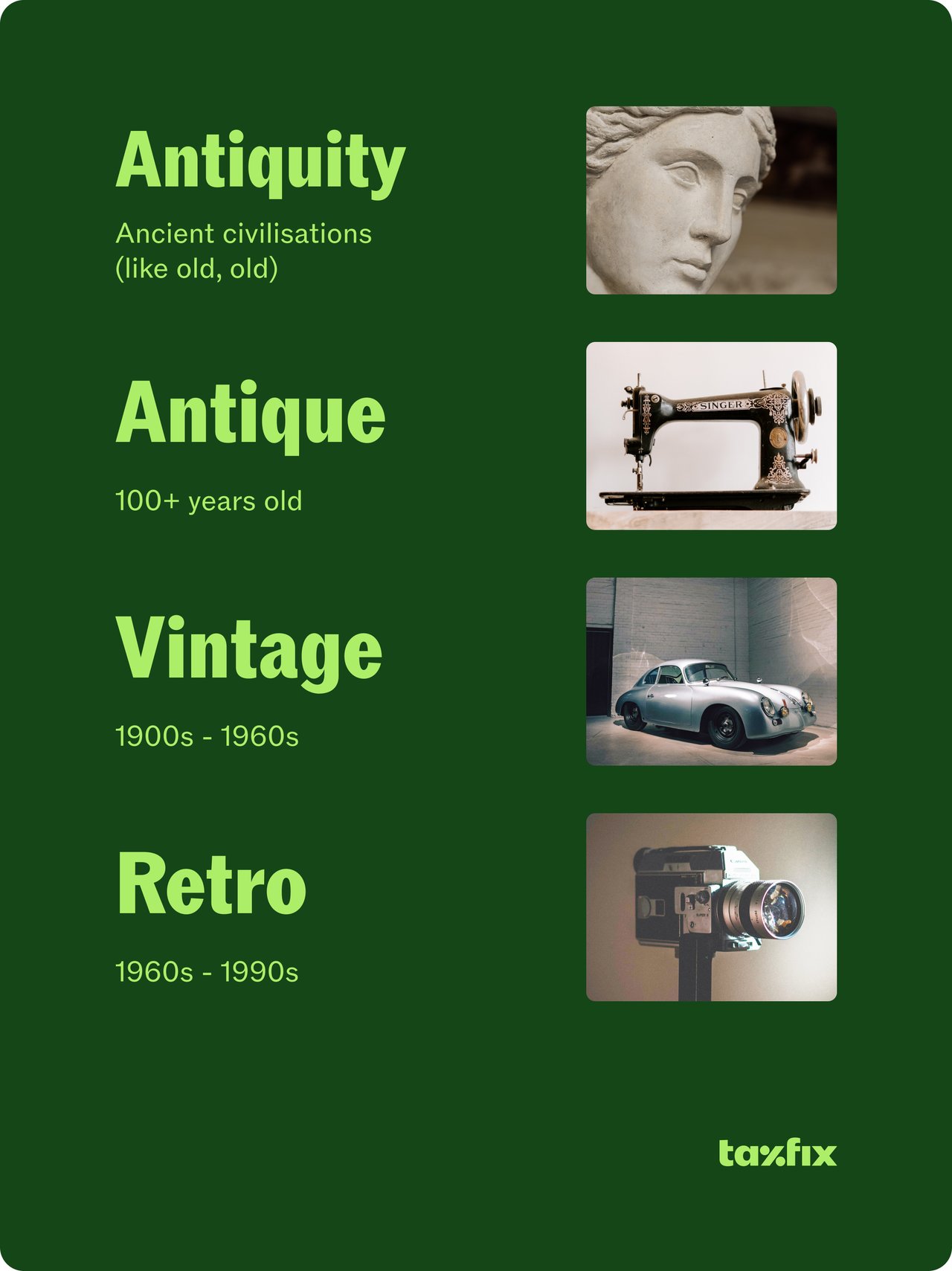
So that game console collecting dust at your dad’s house? Yeah, that’s retro. And those amazing sunglasses your mum got from her mum but won’t let you wear? They’re vintage.
Another interesting (and yes, we’re using the word loosely) point is that every time period has a different focus on items, style, etc. For example, there’s lots of retro or vintage clothing that is popularised, as opposed to antique clothing. Conversely, antique furniture and paintings are far more common and valued than those of their retro counterparts.
Not every item will have a high monetary value.
With that being said, it’s worth trying to gather all the information you have regarding your item to help you prepare to sell further down the line. You can use online resources or speak to antique dealers for an appraisal.
You can have antique:
Furniture 🛋
Jewellery 💍
Clocks 🕰
Kitchenware 🍽
Paintings 🖼
Swords ⚔️
And lots, lots more.
Ok, now what’s a chattel?
A chattel is a really old word (we’re talking 13th century old) and it’s used to describe items of personal property. You have to be able to touch and move the item, so it has to be tangible and movable. So land wouldn’t be considered a chattel but a car would be. Most of the time, they’re considered to be assets or antiques, like jewellery or paintings.
What’s a wasting asset?
One quick differentiation to make is the difference between a wasting asset and just a normal asset or chattel. A wasting asset is exempt from certain taxes because its life expectancy goes down or it has a short lifespan. Racehorses, wine, watches, and vintage cars are examples of this.
A wasting chattel only has an expected useful life of 50 years and is exempt from Capital Gains Tax – woohoo!
Are chattels and antiques taxable?
Yep, disposing or selling of chattels and antiques is taxable. You’ll have to pay Capital Gains Tax on profits.
If you sell your chattel for more than £3,000 but less than £15,000, you’ll need to pay tax on the profit. If your proceeds are less than £3,000, you don’t have to do anything.
HMRC gives you some relief when selling assets. Using the 5/3 (five thirds) rule, you can calculate how much of the profit you’ll be taxed on. This is method one.
Use method two to calculate how much profit you’ll pay tax on by deducting expenses and how much you bought the asset for. You get to choose the lesser of the two figures!
Use our Capital Gains Tax calculator
You’ll pay CGT tax at the basic rate or the higher rate but you can use our CGT calculator to do all the maths for you.
1. Your situation
2. Tax and profit
- Your profit from
shares£20,000£3,000 tax-free CGT allowance?In this tax year, you can make up to £3,000 profit tax-free - Capital Gains Tax to pay£4,004
- Profit after tax£15,996
How your capital gains tax is calculated
The total capital gains tax (CGT) you owe depends on two things:
- How much you earn in total
- What type of assets you sell
Your income level determines which tax rate applies to your gains. Capital gains are stacked on top of your income, so if your total income is above the basic rate band, your gains will be taxed at the higher rate. Our capital gains tax rates guide explains this in more detail.
In your case, with capital gains of £20,000 and total annual earnings of £49,000:
Capital gains tax (CGT) breakdown
You get a tax-free allowance of £3,000. After the allowance, your taxable gain is £17,000.
You pay £229 at 18% tax rate for the next £1,270 of your capital gains
You pay £3,775 at 24% tax rate on the remaining £15,730 of your capital gains
When filling out the assets portion, pictured below, for Capital Gains Tax, you should put in the lower figure.
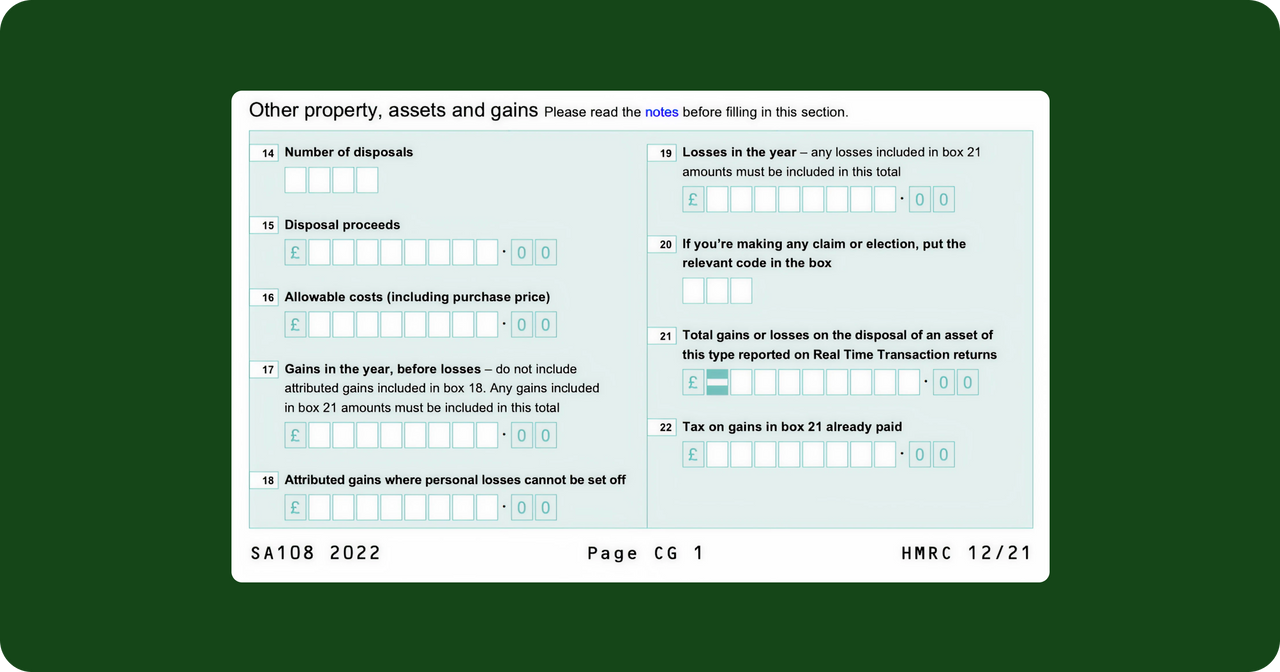
If your proceeds were more than £15,000, use the capital gains summary notes to figure out your chargeable gain, as normal CGT rules will apply.
Antiques and Inheritance Tax
You can hand pieces of art to the Arts Council and HMRC to cover some or possibly all of your Inheritance Tax (IHT) bill. Inheritance Tax is paid on assets you inherit from someone who has passed away..
HMRC’s Acceptance in Lieu (AIL) scheme enables you to transfer heritage assets to an approved museum or art institution to settle any IHT or estate duty that you may owe or may be liable for in the future.
The art, objects, or collections must be considered of “pre-eminent importance” on the basis of their national, scientific, historic or artistic interest and in acceptable condition.
What happens next?
- Contact HMRC ’s heritage team – they’ll check what liability there is for tax and that the offer is being made by you (the person who owes or is liable for the tax)
- If the offer meets the criteria, HMRC will refer it to the AIL Panel of the Arts Council
- The Panel then makes the decision to move forward or not, based on the condition of the asset and what value to accept
Need more advice on your situation?
Get in touch with our accredited accountants to discuss your situation and maximise your tax efficiency!