New name, same trusted service. Learn more
Tax codes explained: What your code means and whether it’s right
A tax code tells your employer or pension provider how much tax-free income you get and how much tax to take from your pay. Here’s what each part means.
Your code in 60 seconds
- The number is your tax-free Personal Allowance, after any adjustments. The last digit is replaced by a letter.
- The letter shows your situation. L means you get the standard Personal Allowance.
- For the standard code, a Personal Allowance of £12,570 for 2026/27 becomes 1257L.
Want to check your code against your salary? Use our tax code checker. For a full breakdown of your tax, try our UK Income Tax calculator.
Your situation


Results

- PAYE earnings£49,000
How your tax code is calculated
There are three main components that determine your tax code:
- What you earn
- Allowances you’re claiming
- Your tax-free allowances
What the numbers in your tax code mean
The number is the tax-free income you get from that job or pension in the tax year. HMRC starts with your Personal Allowance. It then takes off any income you haven’t paid tax on yet, such as untaxed interest. It also takes off other deductions, such as company benefits. The last digit of the result is replaced by the letter.
Rule of thumb: for a standard code, divide your Personal Allowance by 10. For 2026/27, the standard allowance is £12,570, so:
£12,570 ÷ 10 = 1,257
Say your employer gives you medical insurance worth £1,570. That benefit reduces your Personal Allowance to £11,000, so your code becomes 1100L.
What the letters mean
Here’s a list of tax codes and what they mean:
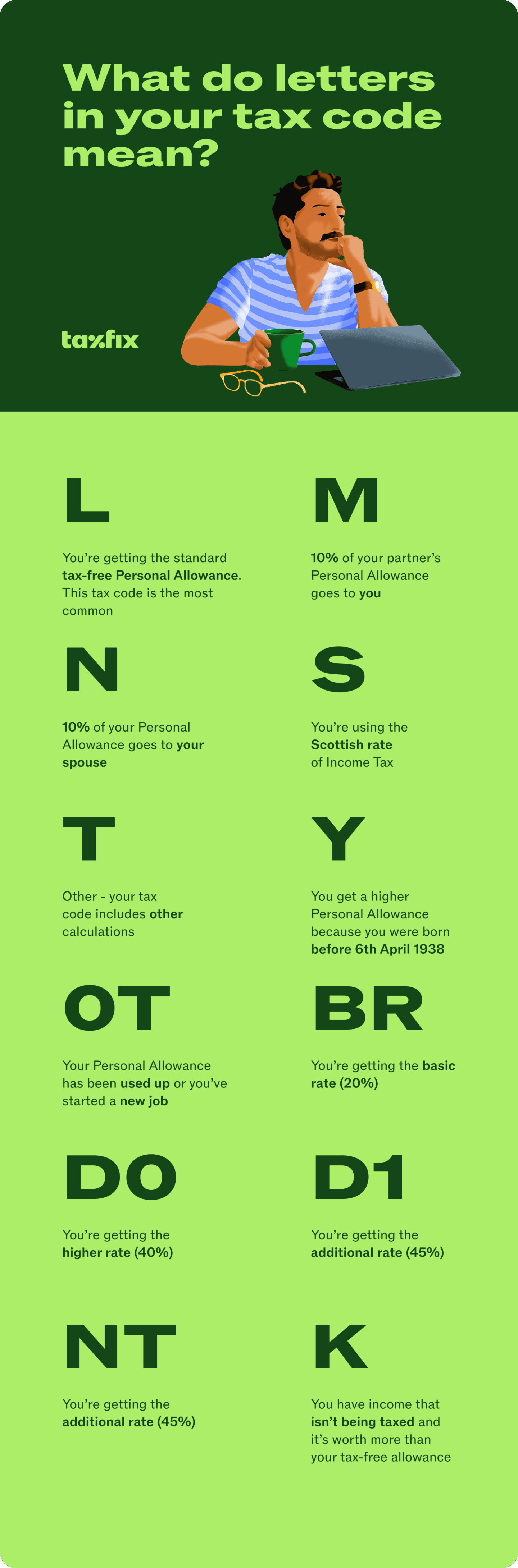
Terms like basic rate or higher rate refer to tax bands, the slices of your income taxed at set rates. If you want more info, read our guide to UK income tax rates and tax bands.
What a K code means
A K code means you have income or deductions that are higher than your Personal Allowance and aren’t already being taxed. This can happen if you:
- owe tax from a previous year, which is collected through your pay or pension
- get the State Pension or taxable state benefits
- get company benefits you pay tax on, such as a company car
- earn more interest on your savings than your Personal Savings Allowance
Your employer or pension provider uses the K code to collect that tax. They can’t take more than half of your pre-tax pay or pension this way.
Want to know more?
Read GOV.UK’s guidance on K codes, or consult the information and recommendations on our tax code checker.
Which tax code should I be on?
For 2026/27, 1257L is the code used by most people with one job or pension. It breaks down like this:
- 1257 comes from the standard Personal Allowance of £12,570.
- L means you get the standard Personal Allowance.
If you have a second job, make sure the job that pays you the most carries the L code, not BR.
Your code may differ from 1257L if:
- you have more than one job or pension, as each one gets its own code
- you have untaxed income, such as savings interest above your Personal Savings Allowance
- you get company benefits, such as a company car
- your income is over £100,000, which reduces your Personal Allowance
To check your code, use our tax code checker.
Emergency tax codes after a new job
If your new employer doesn’t have your starter details, you may be put on an emergency code. These codes end in W1, M1, X or NONCUM, and they’re usually temporary. To help your employer, give them your P45 or fill in the starter checklist.
HMRC can take up to 35 days from your start date to update your code, so give it that time before you get in touch.
Read GOV.UK’s guidance on emergency tax codes for more.
Earning over £100,000: how your Personal Allowance is reduced
Earning over £100,000? Here’s how your Personal Allowance works, and how pension contributions can help you plan.
For every £2 your adjusted net income is above £100,000, your Personal Allowance falls by £1. It reaches zero at £125,140 for 2026/27.
For example, if your adjusted net income is £110,000, your allowance falls by £5,000 to £7,570. That gives a code of 757L.
Pension contributions can reduce your adjusted net income, which may restore part of your Personal Allowance. Use our pension tax relief calculator to see how this could apply to you.
Find out more in our guide to the tax implications of earning over £100k.
When should I contact HMRC about my tax code?
Get in touch with HMRC if:
- you see BR, D0 or D1 on your code, and it isn’t because you have a second job
- you’re on an emergency code more than 35 days after starting a new job
- you think you’ve paid too much or too little tax
To get started, sign in to Check your Income Tax online. If you’d rather call, you can reach HMRC on 0300 200 3300. Have your National Insurance number ready.
What if my tax code is wrong?
- Check and update your details online first. Sign in to Check your Income Tax online and make sure your employment, pension and benefit details are correct.
- HMRC updates your code within 15 working days and tells you and your employer.
- If you’re paid monthly, the new code usually appears on your next or following payslip. If you’re paid weekly, it should be on your third payslip.
Think your code is wrong?
Use our tax code checker.
What happens if I pay too much or not enough tax?
If you’ve paid too much, HMRC usually refunds the difference through your pay once it updates your code. If you’ve paid too little, HMRC may adjust your code to collect the tax over one or more years.
At the end of the tax year, you may get a tax calculation letter (P800) or a Simple Assessment letter. Simple Assessment is used if tax can’t be taken from your income, or if you owe more than £3,000.
Your 2026/27 checklist
- Find your current code. Check it in Check your Income Tax online, the HMRC app, on your payslip or on a Tax Code Notice.
- Confirm your allowance. For 2026/27, it’s £12,570 unless it has been adjusted.
- Check your untaxed income. Savings interest and other income that hasn’t been taxed can affect your code.
- Check your pension details and company benefits. Make sure HMRC has them right.
- Correct HMRC’s details if anything is wrong or missing.
- Get help if your income is complex. Consider Self Assessment or speak to a UK-qualified tax accountant. Taxfix connects you with UK-qualified tax accountants and digital tools to make filing quicker and easier.
- Check again each April, when the new tax year starts.
FAQ: Tax codes explained
What does the letter L mean in my tax code?
L means you get the standard Personal Allowance, which is £12,570 for 2026/27.
What is an emergency tax code?
An emergency code ends in W1, M1, X or NONCUM. It’s usually temporary and often happens when your new employer is missing your starter details.
What does a K tax code mean?
A K code means your untaxed income or tax owed from a previous year is higher than your Personal Allowance. The extra amount is collected through your pay or pension.
Can I have more than one tax code?
Yes. You’ll have one tax code for each job or pension you have.
Which tax code should I be on?
1257L is used for most people with one job or pension. Check your own code with our tax code checker.
What do the S and C letters in a tax code mean?
S means your income is taxed using Scottish rates. C means your income is taxed using Welsh rates.
This article provides general information only and is not personalised tax advice.
Looking for tax help?
Or see our Guides, Calculators or Taxopedia