Finlay Sheikh
Published on: 10.11.2026
Published at: 19.11.2026
Reading time: 4 minutes
How to read a balance sheet
Small biz owners and sole traders , you can use a balance sheet to make sure your business finances are healthy, hearty, and most importantly, accurate.
If you’ve come across these scary-sounding documents before, you know they’re notoriously difficult to decipher. Or maybe you find them easy to decrypt, in which case, give us a call 👀
All jokes aside, we’re here to help you understand balance sheets, without all the complicated jargon.
Finlay Sheikh
Published on: 10.11.2026
Published at: 19.11.2026
Reading time: 4 minutes
What is a balance sheet?
A balance sheet shows how much money your business is worth (net worth) based on its assets, liabilities and equity. The main use is to make sure that your books are – you guessed it – balanced. Another is for people like investors, stakeholders and outside regulators to be able to see the health of a business in the current period, a previous one or even how it might perform in the immediate future.
Here’s what information is on a balance sheet:
- Assets : what the business owns
- Liabilities: what the business owes
- Owner/ shareholder ’s equity: the value of the owner/shareholder’s investment
The basic equation is:
Assets – Liabilities = (owner/shareholder’s) Equity
There are two types of assets and liabilities:
1. The first one is current assets or current liabilities.
- They can be paid within the current financial year
2. The second type is non-current assets or non-current liabilities.
- They will be paid over time, past the current financial year
Alternatively, you can also refer to them as short-term (current) or long-term (non-current).
Here are some examples:
- Current assets: cash and cash equivalents (that can easily be converted to cash within 1 year)
- Non-current assets: property, plant and equipment (PP&E)
- Current liabilities: accounts payable (what you owe suppliers), wages, taxes, rent, etc.
- Non-current liabilities: bank loans and debts
What is equity?
Equity is the value of what’s left over after you deduct what the company owes (liabilities) from what it owns (assets). That amount is what would go to the owner or shareholders. It essentially represents a shareholder’s or owner’s stake in the company.
As we mentioned, equity = assets – liabilities.
Equity can either be negative, meaning the liabilities outweigh the assets, or it can be positive meaning that there are enough assets to cover the liabilities.
How to make a balance sheet
To make your own balance sheet, you need to know a few things about the finances of your company. Oh, and also some maths, so we recommend keeping a calculator handy. Or, if you’re really tech-savvy, you can use a spreadsheet to do the calculations for you 👩💻
You’ll need to know the total amount of current/non-current assets and liabilities that the company has.
Once you’ve got that data, you can start maths-ing and forming your balance sheet for the current accounting period. Here’s an example of what a balance sheet looks like.
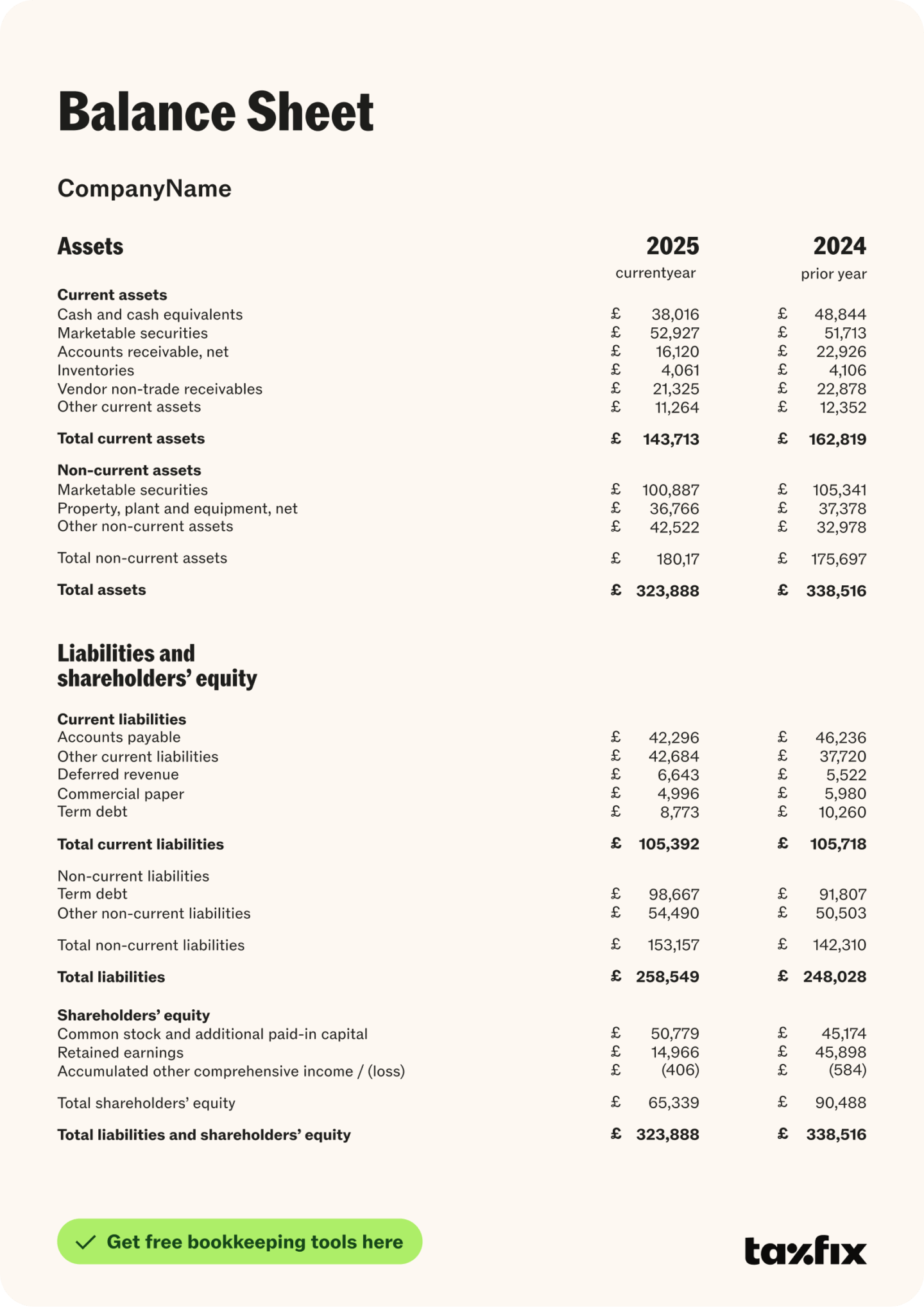
Or just use our template and fill it in to suit you and your business. HMRC also has a template you can follow on their website .
Remember, the goal is to make sure everything balances out at the end. What you own should pay off what you owe and leave you with the leftover equity.
Should a balance sheet always balance?
Yep, it should always, always balance.
If it doesn’t, then there could be another explanation. Here are a few reasons for an unbalanced sheet:
- Incomplete data
- Wrong data
- Currency exchange rate errors
- Inventory mistakes
- Incorrect equity calculations
- Miscalculated load amortization (writing off) or depreciation (losing value)
What is balance sheet reconciliation?
It’s when you compare a company’s balance sheet to the general ledger (assets, liabilities, equity, income, expense, gain, and loss transactions of a business) to verify the accuracy of the balance sheet. So, what happens if your balance sheet doesn’t balance? Balance sheet reconciliation.
Translation: Every transaction within the business needs to fall under the asset or liability category and they should all balance to the correct amount of equity.
Once you confirm everything matches, you can be extraordinarily relieved to know that your books are balanced!
That’s one less thing to worry about🙌
Take the path that’s hassle-free
If you’re looking for an easier way to keep things in order, our free bookkeeping tools have got you covered in that department.
Create and send invoices, pull your spending straight from your bank account, and track your incomes and expenses from your accounting dashboard. All in one place.
Plus, you can choose to get extra support from an accredited accountant, if you need it!